
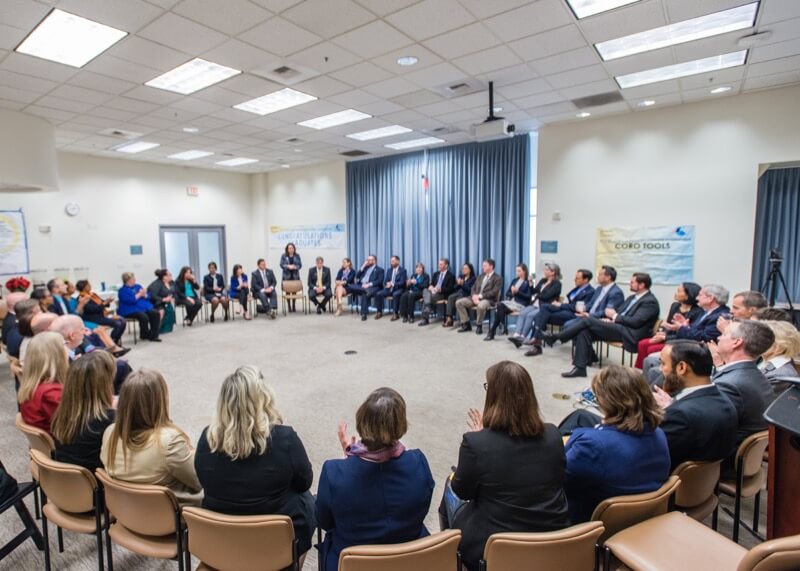
A session from one of Coro’s leadership development programs.
You’ve found the right leadership development program. You’ve read the curriculum, looked at the calendar, and pictured yourself in the cohort. Then comes the part many candidates find awkward and the hardest: asking your employer to sponsor your professional development and give you the time to fully participate.
That conversation can feel like asking for a favor. Approached with care, it becomes a win for you, your team, and your organization.
Many participants in Coro California’s programs secure employer support for tuition. Here’s how to make your case.
Start with Coro’s framework: look inward, outward, and forward
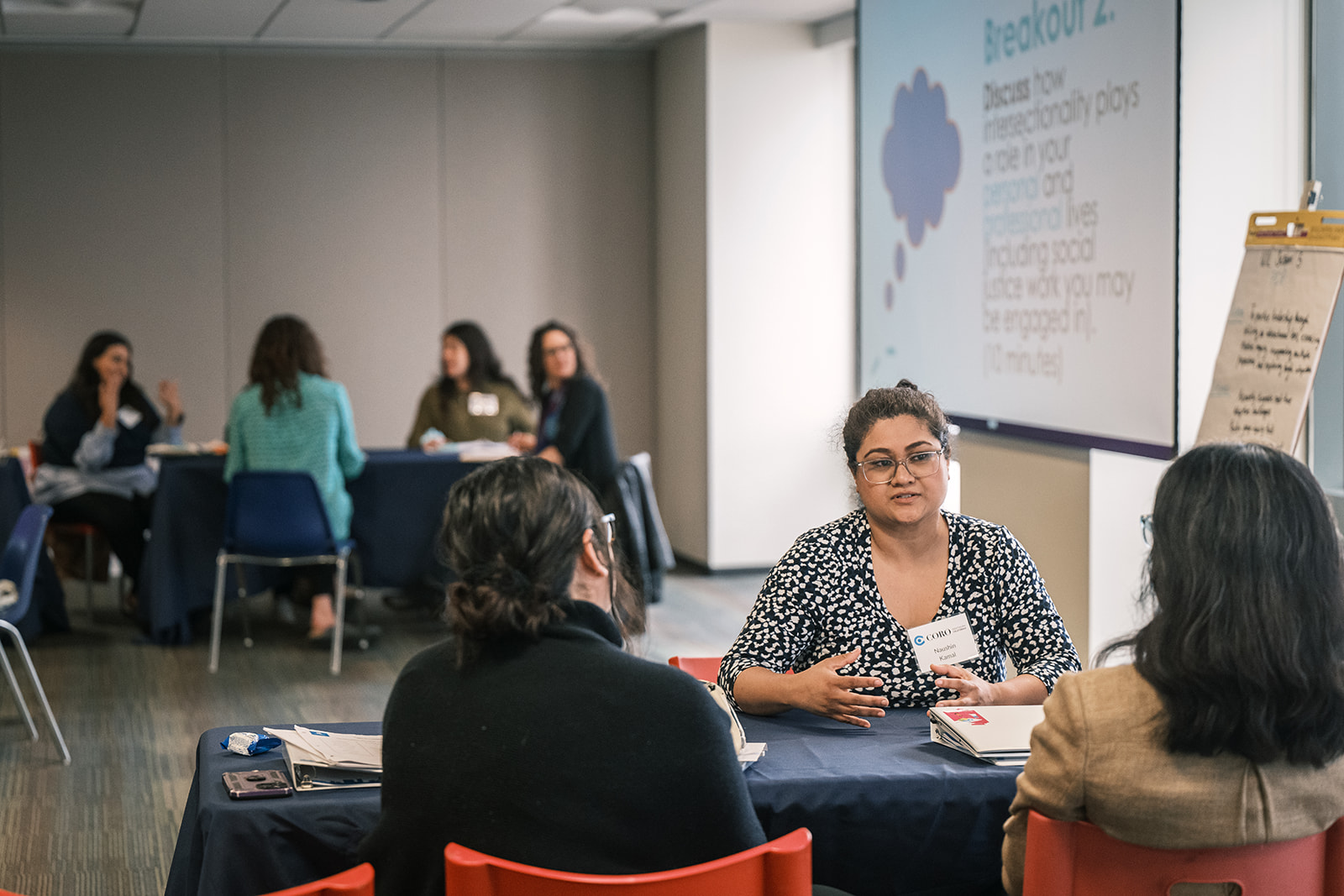
Coro’s leadership approach asks leaders to look inward at their motivations, outward at the people they lead and work with, and forward at the goals they’re working toward. It’s also a practical way to prepare for a conversation about employer-sponsored leadership training.
Look inward: get clear on your why
Before you talk to your manager, spend time with your own motivations. What leadership challenge are you facing right now? Where do you want to grow? Maybe you recently stepped into managing a team, you’re navigating a major organizational change, or you want to build relationships across sectors that would strengthen your work.
The more specific you are, the more persuasive you’ll be.
“I want to grow as a leader” is a start. “I’m managing a team of six for the first time, and I want stronger tools for giving feedback and leading through change” is a case.
Look outward: understand what your organization needs
Your manager is weighing your request against budgets, deadlines, and team priorities. Think about the request from their perspective. What goals is your organization working toward this year? What gaps exist on your team? Who else needs to approve a training budget request: your direct supervisor, HR, a department head?
This is a small exercise in stakeholder analysis, a skill practiced across Coro programs. Knowing who decides, and what they care about, lets you frame your request in terms that matter to them.
Look forward: answer “To what end? In service of what?”
Coro leaders return to these questions often, and they’re the heart of a strong ask.
Connect the program directly to the outcomes your organization values: stronger team management, better cross-sector partnerships, improved retention, a more confident leader ready for greater responsibility.
Leadership training is an investment in your organization’s capacity, and your request should show exactly how that investment pays off.
Making the case for employer-sponsored professional development

Know the numbers, and lead with value
Come prepared with clear figures. Coro’s program tuition is significantly subsidized by generous donor support and ranges from a few hundred dollars to several thousand, depending on the program.
Our issue-based networks, including the Affordable Housing Leadership Network, Climate Resilience Leadership Network, and Housing & Houselessness Leadership Network, are subsidized down to just a few hundred dollars.
Tuition for the Board Leadership Training Accelerator, Women in Leadership, Lead Fellowships, and the Executive Leadership Network ranges from just under $3,000 to around $9,000 with donor support applied.
Each program page lists both the subsidized tuition and the program’s full value, so share both with your manager. Seeing what donors have already invested helps decision-makers understand the value of the opportunity in front of them.
Use the Program Benefits Guide
Each Coro program has a Program Benefits Guide designed for exactly this conversation. It outlines the skills you’ll build, the format, and the value to your organization. Share it with your manager ahead of time so they can review it before you meet, and bring a copy to the conversation.
Hear directly from Coro alumni as they share their stories and the tangible impact Coro’s programs have had on their personal and professional development.
Be specific about time off
For many employers, the time commitment raises as many questions as the cost.
Review the program calendar and share exact dates up front. For example, Lead Fellowships include about 90 hours of professional development from September through May, Women in Leadership includes over 60 hours across 10 in-person sessions over four months, and the Executive Leadership Network includes over 50 hours across eight sessions from March through June.
Then offer a coverage plan.
Identify who can support key responsibilities on session days, flag any conflicts with major deadlines, and show how you’ll stay on top of your work. A thoughtful plan signals the kind of leadership you’re hoping to grow.
Look for existing professional development budgets
Many organizations already set aside funds for staff growth, even if they aren’t widely advertised. Ask HR about professional development funds, tuition assistance or reimbursement programs, learning and development budgets, or team training budgets.
Timing matters too. If your organization plans budgets around a fiscal year, raising your request early gives your manager the best chance to make room for it.
Show how you’ll bring the learning back
Employers want to know the value extends beyond one person.
Offer to share frameworks with your team, lead a lunch-and-learn after key sessions, or apply what you learn to a current project. Coro programs are built on hands-on learning with real-world application, so you’ll have plenty to bring back from day one.
Explore shared and alternative paths
If your employer can’t cover full tuition, there are still options.
Consider proposing a split, where your organization covers part of the cost.
Coro also offers partial, need-based scholarships and payment plans for qualified applicants; complete the scholarship questions in your application to be considered. Applying by an early decision deadline can also lower your cost and give you priority consideration for scholarships.
A sample request to adapt
Here’s a short email you can tailor to your situation:
Hi [Manager’s name],
I’d like to talk with you about a professional development opportunity: Coro California’s [Program Name], a [length] leadership program for [audience]. It focuses on [two or three skills most relevant to your role], which connect directly to [team or organizational goal].
The program requires [time commitment], and I’ve attached the calendar along with a plan for covering my responsibilities on session days. Tuition is $[amount], subsidized from $[full value] by donor support. I’ve also attached the Program Benefits Guide, which outlines the value for our organization.
I’d love to find 20 minutes to discuss whether our professional development budget could support this. I’m also happy to share what I learn with the team throughout the program.
Thank you,
[Your name]
A few final words of advice
Start the conversation early, ideally before you apply.
Your employer may need time to review budgets or secure approvals, and Coro tuition payments are typically due within a few weeks of your decision notification.
Be honest about what you hope to gain, including the areas where you want to grow. The same self-awareness that makes a strong Coro application also makes a compelling request.
If the answer is “not right now,” ask what would make it possible next cycle. That feedback is valuable, and it keeps the door open. And don’t let it keep you from applying. Coro’s need-based scholarships, payment plans, and one-cycle deferrals give applicants real options, and a scholarship award or deferral can be a natural moment to reopen the conversation with your employer when the timing or budget is a better fit.
About Coro California’s leadership development programs

Coro California’s leadership training programs are immersive, cohort-based experiences for leaders at every stage, from high school students to senior executives. Participants learn by doing, work across differences, and practice ethical leadership alongside peers from business, government, nonprofit, and community sectors. Every Coro leader joins a lifelong network of 15,000+ alumni committed to strengthening California’s communities.
Start your leadership journey
When you are ready to take the next step, explore Coro California’s programs, submit an interest form, or schedule a call with our team to talk through program fit, financial support, and how to make the case to your employer.

Carson Bruno
Ready to strengthen your leadership impact?
Explore programs designed to equip leaders with the skills to drive change.